Updated 9/22/2026
Direct Embedded vs. Drilled Pier Foundations for Transmission Poles
There are several methods for installing steel transmission poles, but two common foundation methods are direct-embedded foundations and drilled pier foundations.
The primary difference is how the pole is supported. A direct-embedded pole is placed directly into the ground and backfilled, while a drilled pier foundation uses reinforcing steel, anchor bolts, and concrete to create a foundation to which the pole is attached.
The appropriate foundation method depends on several factors, including structure type, foundation loads, soil properties, geological conditions, design limitations, accessibility, environmental restrictions, and budget.
What Foundation Methods Are Used for Steel Transmission Poles?
ASCE 48-11, Design of Steel Transmission Pole Structures, identifies three specific methods used to place a steel transmission pole into the ground:
- Drilled shaft foundation with anchor bolts
- Direct-embedded foundation
- Embedded casing foundation
Other methods, including spread, pile, and rock anchor foundations, may be used for more specific applications.
This article focuses on two methods: drilled shaft foundations, also known as drilled pier foundations, and direct-embedded foundations.
What Factors Determine the Foundation Type for a Transmission Pole?
When determining which foundation method is best suited for a steel transmission pole, several considerations should be addressed during the initial design.
These include:
- Type of structure
- Importance of the structure
- Allowable foundation movement or rotation
- Geological conditions
- Soil properties
- Foundation loads
- Design limitations
- Equipment availability and accessibility
- Environmental restrictions
- Cost and budget
These factors can influence whether a direct-embedded or drilled pier foundation is appropriate for a particular structure.
What Is a Direct-Embedded Transmission Pole?
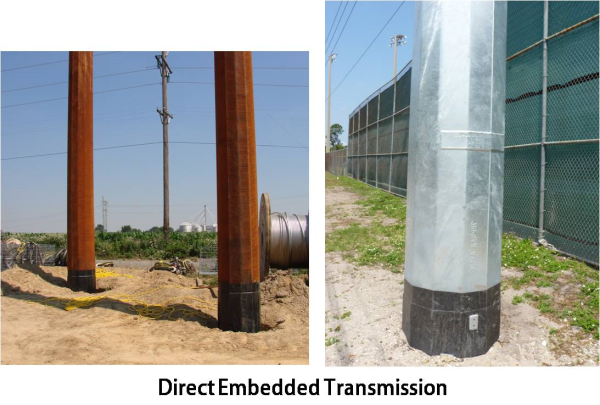
A direct-embedded transmission pole is installed by digging a hole, placing the pole directly into the ground, and backfilling around it with rock, concrete, or another specified backfill.
Direct embed tends to be more economical than a concrete foundation because of this relatively straightforward installation method.
Direct-embedded poles are typically used for tangent and light-angle structures where overturning moments are smaller.
As loads become larger, embedding a pole becomes less favorable because the foundation relies on the pressure of the specified backfill to resist the pole from coming out of the ground.
[Keep existing direct-embedded transmission pole image here]
What Is a Drilled Pier Foundation?
A drilled pier foundation uses reinforcing steel, anchor bolts, and concrete to create a foundation for a steel transmission pole.
After the hole is dug, a combination of reinforcing steel and anchor bolts is lowered into place, followed by concrete.
Drilled pier foundations are typically used for medium- to heavy-angle structures and dead-end steel structures.
The concrete foundation is larger in diameter than the pole. Its weight and size allow it to engage more soil and provide a greater bending force at the base.
[Keep existing drilled pier foundation image here]
Direct Embedded vs. Drilled Pier Foundations: What's the Difference?
Both methods provide foundations for steel transmission poles, but they differ in their construction and typical applications.
| |
Direct Embedded |
Drilled Pier |
| Installation |
Pole is placed directly into the ground and backfilled |
Reinforcing steel and anchor bolts are placed in the hole, followed by concrete |
| Typical structures |
Tangent and light-angle structures |
Medium- to heavy-angle and dead-end structures |
| Load considerations |
Typically used where overturning moments are smaller |
Used where loads require a larger foundation |
| Economics |
Tends to be more economical than a concrete foundation |
Requires a concrete foundation |
| How it engages the soil |
Relies on pressure from the specified backfill |
Larger-diameter concrete foundation engages more soil |
Frequently Asked Questions About Transmission Pole Foundations
What is the difference between direct embed and drilled pier foundations?
A direct-embedded transmission pole is placed directly into the ground and surrounded with specified backfill. A drilled pier foundation uses reinforcing steel, anchor bolts, and concrete to create the foundation for the transmission pole.
When are direct-embedded poles typically used?
Direct-embedded poles are typically used for tangent and light-angle structures where overturning moments are smaller.
When are drilled pier foundations typically used?
Drilled pier foundations are typically used for medium- to heavy-angle structures and dead-end steel structures.
Is a direct-embedded foundation more economical than a drilled pier foundation?
Direct embed tends to be more economical than a concrete foundation because installation essentially involves digging a hole, placing the pole into the ground, and backfilling it with rock, concrete, or another specified backfill.
What factors should be considered when selecting a transmission pole foundation?
Foundation selection can depend on the structure type, importance of the structure, allowable foundation movement or rotation, geological conditions, soil properties, foundation loads, design limitations, equipment availability and accessibility, environmental restrictions, and budget.
Choosing the Right Foundation for a Steel Transmission Pole
Direct-embedded and drilled pier foundations each have applications in steel transmission pole design. Direct embed is typically used for tangent and light-angle structures where overturning moments are smaller, while drilled pier foundations are typically used for medium- to heavy-angle structures and dead-end structures.
The appropriate foundation method ultimately depends on the specific project. Structure type, foundation loads, soil and geological conditions, design limitations, accessibility, environmental restrictions, and budget should all be considered when determining the foundation approach.